

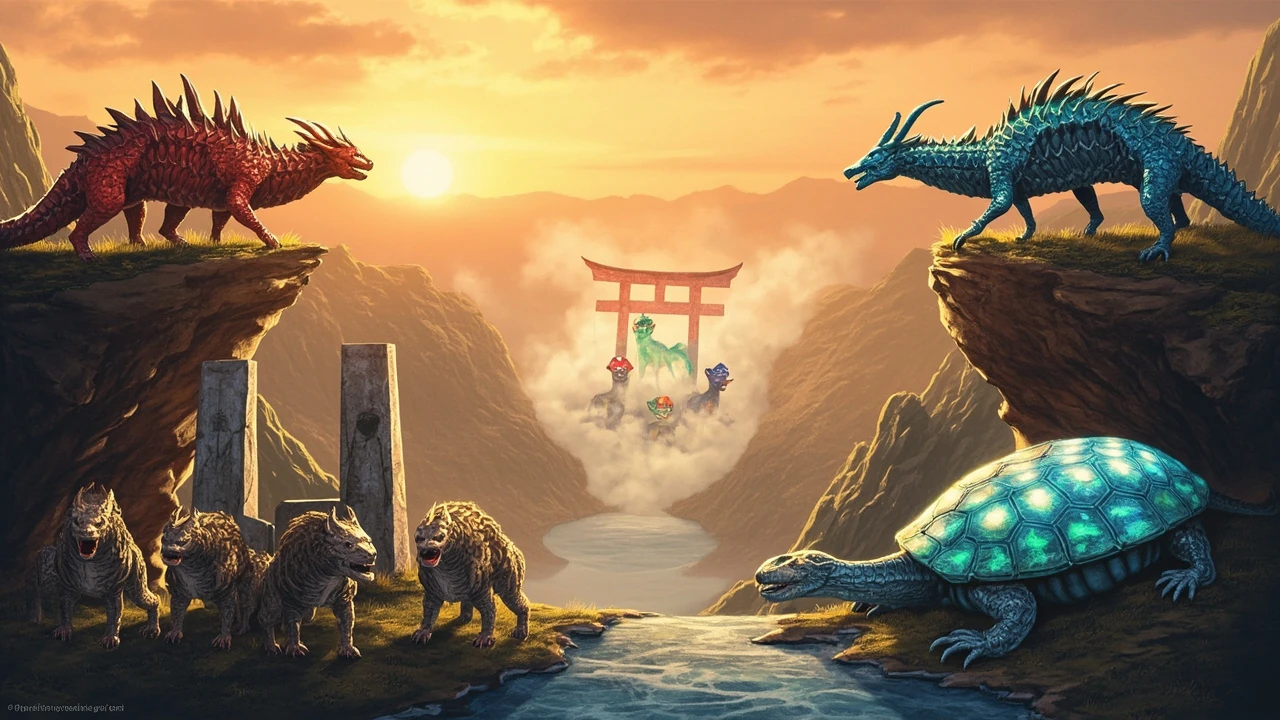
Pokemon Scarlet and Violet legendaries: how the generation’s flagship roster fits together
The Pokemon Scarlet and Violet legendaries are not a single category of creature so much as a layered cast that Game Freak and The Pokemon Company introduced across three release waves: the November 2022 base game, the December 2022 and spring 2023 DLC drops, and the late 2023 epilogue content. For most players, the practical question is simple. Which creatures count as legendaries, which are mythicals, which are version-exclusive, and which can still be obtained today if you start a fresh save on Nintendo Switch or Switch 2 through backward compatibility. The answer depends on which edition you own, whether you have access to The Hidden Treasure of Area Zero, and whether your save predates the version 3.0.1 patches that closed several event-only encounters.
Game development context matters here because the encounter design itself reflects a deliberate split. Koraidon and Miraidon are treated as story-locked partners with a custom sprinting, swimming, and gliding moveset that doubles as your open-world traversal system. The Treasures of Ruin, the Loyal Three, Ogerpon, Terapagos, and Pecharunt follow the older template of a single encounter triggered by quest progression. Understanding which category a creature belongs to determines whether you can trade it, whether you can shiny hunt it, and whether you can still get it without older event codes.
This article covers the full roster as it stands after the version 3.0.1 cycle, explains how each encounter works mechanically, and flags the creatures that have become unavailable for new players. Where The Pokemon Company has not clarified a window, the article says so rather than guessing. It also covers the mechanics that have quietly changed since launch, because the encounter system itself was patched more than once across 2023 and 2024.
The box legendaries: Koraidon and Miraidon
Koraidon is the mascot legendary of Pokemon Scarlet, and Miraidon is the mascot of Pokemon Violet. Each is version-exclusive and each is required to complete the main story, so trading is the only practical way to obtain the opposite box legendary without a second copy of the other edition. The two creatures function as ride replacements for the previous generation’s HMs, with Koraidon favoring raw physical sprinting and Miraidon favoring a hovering glide, but those traversal differences are cosmetic from a stats perspective.
Mechanically, both Pokemon share the same base stat total of 670, the same Dragon and Fighting typing for Koraidon, and the same Dragon and Electric typing for Miraidon. Their hidden abilities, Orichalcum Pulse and Hadron Engine, change the weather or terrain on entry and boost certain move categories. Neither ability is available outside the encounter itself, so trading between versions is the only way to acquire the other ability for competitive use.
Encounter-wise, you cannot soft reset Koraidon or Miraidon in the traditional sense. The story encounter is fixed, and the only way to obtain a different nature, hidden ability reset, or alternate form is to trade with another player or restart the file. Shiny hunting is possible through the post-game Outbreak farming method introduced in version 1.2.0, but the shiny rate for the box legendaries was later adjusted to match the standard 1 in 4096 odds for static encounters, which makes them some of the rarest legitimate targets in the generation.
There is one quirk worth remembering: Koraidon and Miraidon cannot be deposited into Pokemon HOME unless the player has completed the main story and registered them in the Paldea Pokedex. The restriction is a leftover from the launch window when HOME support first went live, and it still trips up players who try to move a freshly caught box legendary into a backup box before finishing the campaign.
The Treasures of Ruin: the version-exclusive four from The Teal Mask
The Treasures of Ruin are a set of four ruin-themed Pokemon introduced in The Teal Mask, the first half of The Hidden Treasure of Area Zero DLC. Wo-Chien, Chien-Pao, Ting-Lu, and Chi-Yu each carry a single Ruinous Tablet as their held item, and each is version-exclusive in a way that splits the quartet across the two editions. Wo-Chien and Chien-Pao appear on Scarlet save data, while Ting-Lu and Chi-Yu appear on Violet save data, but trading bypasses the exclusivity entirely once both players own the relevant DLC content.
From a design standpoint, the four share a thematic throughline about forgotten calamity gods that were sealed into tablets by a long-vanished clan. The encounter is triggered by collecting the corresponding tablet during the Kitakami Road side stories, then returning it to the sealed ruin. Each ruin is a short, fixed encounter with a single fight, so soft resetting remains the standard method for hunting specific natures, but the ruin Pokemon cannot be shiny hunted through normal play because they are scripted encounters with a 1 in 4096 base rate.
Statistically, the Treasures of Ruin sit at a base total of 580, the same as most mid-tier fully evolved Pokemon of previous generations, but their unique typing and signature moves give them a much higher effective ceiling. Wo-Chien is Grass and Dark with a physical leaning, Chien-Pao is Dark and Ice with blistering speed, Ting-Lu is Ground and Dark with enormous physical bulk, and Chi-Yu is Dark and Fire with one of the highest special attack stats in the game. The shared Dark typing makes them vulnerable to Fairy, Bug, and Fighting, but each has a coverage move pool that lets it threaten common switch-ins.
A small but useful detail: the Ruinous Tablet held by each Treasure of Ruin counts as a signature item for that Pokemon, which means it cannot be removed and used on other creatures. The item is essentially a cosmetic flag, but it does change how the creature appears in the trade window and in battle preview, and competitive players have used that visual cue to confirm the source encounter during online trades.
The Loyal Three: Okidogi, Munkidori, and Fezandipiti
The Loyal Three are the mask-themed trio that Ogerpon calls her retainers in The Teal Mask. They are Dark-type specialists that lean into special attack, special defense, and physical attack, with one of the three taking a poison or psychic secondary typing. All three are version-exclusive in the same way the Treasures of Ruin are, with two on one edition and one on the other, but trading makes the full trio accessible regardless of which version you own.
Encounter-wise, the Loyal Three are obtained through a single quest chain that culminates in three separate boss battles inside the Timeless Woods. Like the Treasures of Ruin, they are static encounters with no mass outbreak equivalent, which means soft resetting for the desired nature is the practical farming method. Their stat totals are 530 each, lower than the Treasures of Ruin, but their ability Toxic Chain and the Loyal Three’s signature moves give them a surprising amount of utility in competitive play.
What makes the Loyal Three interesting from a game design angle is that they were positioned to be the central antagonists of the Teal Mask story but were retooled into a sympathetic group after the player resolves Ogerpon’s conflict. The masks they wear are visible cosmetic elements that change color in their Shiny form, which is a small but welcome detail for collectors who care about model swaps over palette swaps.
Okidogi is Poison and Fighting, Munkidori is Poison and Psychic, and Fezandipiti is Poison and Dark, which gives the trio a poison backbone that pairs oddly well with their Dark coverage. The shared poison typing means Fairy, Ground, and Psychic resist most of their STAB options, but each member has a secondary move pool that compensates for the shared weakness profile.
Ogerpon: the face of The Teal Mask
Ogerpon is the box legendary of the Teal Mask DLC, and unlike the Loyal Three, she is the same species on both versions. What changes between editions is the face on her mask and the type that the mask adds to her Grass base typing. Teal Mask Ogerpon is pure Grass, Hearthflame Mask is Grass and Fire, Wellspring Mask is Grass and Water, and Cornerstone Mask is Grass and Rock. Each mask is unlocked by a separate quest that culminates in a rematch with Ogerpon, and only one mask can be equipped at a time.
The mechanic worth noting is that the masks are not cosmetic. Each mask gives Ogerpon a signature move, a defensive stat boost while the mask is intact, and a typing shift that changes her weakness profile. Because Ogerpon’s ability, Embody Aspect, grants a stat boost when she Terastallizes while holding a specific mask, competitive players treat the four masks as four separate builds on the same Pokemon.
Ogerpon’s base stat total of 550 is low for a legendary by modern standards, but her design philosophy is closer to a high-tier standard Pokemon than a generation-defining mascot. She is a fast physical attacker with a flexible coverage pool, and her four forms give her a role compression that has made her a common sight in ranked doubles formats since the DLC released.
One often-overlooked detail: the Hearthflame, Wellspring, and Cornerstone forms are obtained through three separate post-game quests, not through the main Teal Mask story. The main story unlocks the Teal Mask form only, and players who want the full set need to clear all three mask-related side stories before the encounter is available in its strongest version.
Terapagos: the face of The Indigo Disk
Terapagos is the box legendary of the Indigo Disk DLC, and its gimmick is that it transforms. The base form looks like a small blue turtle and is purely a stat-stick with a base total of 400. The Terastal form raises that to 450 and shifts its typing to Normal. The Stellar form, unlocked by completing the main DLC storyline, raises the total to 595, gives it the Stellar typing, and unlocks the signature move Tera Starstorm.
From a design perspective, Terapagos doubles as a thematic capstone for the generation because its Stellar form is a nod to the Terastal mechanic itself. The Pokemon is essentially the personification of the generation’s signature battle system, and its stat distribution leans heavily into defense and special defense, with enough offensive presence to threaten common switch-ins.
The encounter is fixed and cannot be shiny hunted outside soft resetting. The Stellar form is unlocked automatically after the Indigo Disk main story, and the player does not need to trade to obtain the other forms because the transformation is internal. Terapagos is one of two legendaries in the generation that does not have a version-exclusive form, which makes it the most accessible of the DLC boxes for solo players.
A small note for breeders: Terapagos cannot be bred under any circumstances, and its egg group entries were deliberately left blank in the official data. That decision was confirmed in the Indigo Disk patch notes, and it removes a common shortcut that competitive players used in previous generations to chain-perfect legendary substitutes.
Pecharunt: the mythical of the epilogue
Pecharunt is the mythical Pokemon tied to the Mochi Mayhem epilogue event, which was distributed through a serial code that expired in late 2024. As of the version 3.0.1 cycle, no in-game method to obtain Pecharunt has been added for players who missed the distribution. The Pokemon is a Poison and Ghost type with a base stat total of 600 and a signature move called Malignant Chain, which has a small chance to badly poison the target.
For players who want a Pecharunt today, the only legitimate methods are trading with a player who redeemed the event before the code expired or waiting for a rumored rerun. The Pokemon Company has historically rerun mythical distributions during anniversary windows, but no rerun has been confirmed for Pecharunt on Nintendo Switch or any future platform. Until an official rerun is announced, treat Pecharunt as a permanently gated mythical.
Pecharunt is also unique among the generation’s mythicals because it is plot-relevant. The Mochi Mayhem epilogue ties directly into the Teal Mask storyline, and the encounter itself is delivered as an event quest rather than a standard distribution. That distinction matters because event quests typically appear in the Mystery Gift menu even after the distribution code expires, while code-based mythicals like Darkrai and Shaymin in earlier generations have been re-released through new codes or events.
How the legendaries break down by type and stat total
The legendaries of Pokemon Scarlet and Violet are not a uniform group. They span a wide range of stat totals, cover nearly every type, and split cleanly between story-locked partners, static quest encounters, and mythical event distributions. The table below summarizes the confirmed legendaries as of the current generation, with version exclusivity and the minimum method to obtain each one. A dash in the Version column means the Pokemon is the same on both editions.
| Pokemon | Typing | Base stat total | Version | How to obtain |
|---|---|---|---|---|
| Koraidon | Dragon, Fighting | 670 | Scarlet | Main story encounter |
| Miraidon | Dragon, Electric | 670 | Violet | Main story encounter |
| Wo-Chien | Grass, Dark | 580 | Scarlet | Teal Mask quest encounter |
| Chien-Pao | Dark, Ice | 580 | Scarlet | Teal Mask quest encounter |
| Ting-Lu | Ground, Dark | 580 | Violet | Teal Mask quest encounter |
| Chi-Yu | Dark, Fire | 580 | Violet | Teal Mask quest encounter |
| Okidogi | Poison, Fighting | 530 | Scarlet | Teal Mask quest encounter |
| Munkidori | Poison, Psychic | 530 | Violet | Teal Mask quest encounter |
| Fezandipiti | Poison, Dark | 530 | Violet | Teal Mask quest encounter |
| Ogerpon (Teal Mask) | Grass | 550 | Both | Teal Mask quest encounter |
| Ogerpon (Hearthflame) | Grass, Fire | 550 | Both | Teal Mask post-game |
| Ogerpon (Wellspring) | Grass, Water | 550 | Both | Teal Mask post-game |
| Ogerpon (Cornerstone) | Grass, Rock | 550 | Both | Teal Mask post-game |
| Terapagos (Stellar) | Stellar | 595 | Both | Indigo Disk story encounter |
| Pecharunt | Poison, Ghost | 600 | Both | Event distribution (expired) |
Two design choices stand out from the table. First, the box legendaries are clearly separated from the rest of the group by a 90-point stat gap, which gives Koraidon and Miraidon a tier above every other creature on the list. Second, the Teal Mask set is the most type-diverse, with seven of the ten Teal Mask creatures carrying a Dark secondary typing. That concentration explains why the Indigo Disk main story briefly introduced new Fairy-type content as a soft counterbalance to the type density in the DLC roster.
Looking at the same data from a different angle, the table also shows that the generation’s stat curve is flatter than the previous two generations. The narrow band between 530 and 600 for the DLC set means competitive players often pick based on typing and ability rather than raw stat total, which is a clear departure from the Sun and Moon generation where the box legendaries sat well above the rest of the cast.
Type matchup table for the Scarlet and Violet legendary pool
Type matchups matter more in this generation than in most, because the DLC pool leans heavily into Dark, Poison, and Grass secondary typings. The condensed table below highlights the four-way, six-way, and two-way weaknesses of each legendary, which is enough information to plan a defensive core without needing the full type chart. The “Quad weak” column flags creatures that take four times damage from a single type, and “Immune” lists any type the creature does not take damage from at all.
| Pokemon | Primary weaknesses | Quad weak | Resists | Immune |
|---|---|---|---|---|
| Koraidon | Fairy, Ice, Ground, Psychic | Fairy | Fire, Water, Grass, Electric, Bug | None |
| Miraidon | Ground, Ice, Dragon, Fairy | Ground | Fire, Water, Grass, Flying, Electric | None |
| Wo-Chien | Fairy, Fighting, Ice, Bug, Poison | None | Water, Electric, Grass, Dark, Ground | Psychic |
| Chien-Pao | Fairy, Fighting, Bug, Fire, Rock, Steel | None | Dark, Ice, Ghost, Psychic | None |
| Ting-Lu | Water, Grass, Ice, Fighting | None | Poison, Rock, Electric, Dark | Electric, Psychic |
| Chi-Yu | Ground, Rock, Water | Ground | Fire, Grass, Ice, Dark, Steel | None |
| Okidogi | Ground, Psychic, Flying | None | Grass, Fighting, Poison, Bug, Rock, Dark, Ice | None |
| Munkidori | Ground, Ghost, Dark | None | Grass, Fighting, Poison, Psychic, Fairy | None |
| Fezandipiti | Ground, Psychic | None | Grass, Fighting, Poison, Bug, Dark, Ice, Fairy | None |
| Ogerpon (Teal) | Fire, Ice, Flying, Poison, Bug | None | Water, Electric, Grass, Ground | None |
| Ogerpon (Hearthflame) | Flying, Poison, Rock | None | Water, Electric, Grass, Ground, Steel, Bug, Fire | None |
| Ogerpon (Wellspring) | Poison, Bug, Flying, Ice | None | Water, Electric, Grass, Ground, Steel, Fire | None |
| Ogerpon (Cornerstone) | Fighting, Ice, Steel, Water | None | Electric, Normal, Rock, Poison, Bug | None |
| Terapagos (Stellar) | Varies by Tera type | None | Varies by Tera type | None |
| Pecharunt | Ground, Psychic, Ghost, Dark | None | Grass, Fighting, Poison, Bug, Ice, Fairy | Normal, Fighting |
The table is worth keeping in mind for raid planning, where the AI often leads with a coverage move that punishes a switch. The quad-weak entries for Koraidon, Miraidon, and Chi-Yu are the most punishing, because a single mispredicted switch into a Fairy, Ground, or Ground-type move can swing an entire raid lobby.
Version exclusivity, trade rules, and what is actually locked
Version exclusivity in Pokemon Scarlet and Violet works on a simple model. Each edition of the base game and each half of the DLC has a fixed list of creatures that appear only on that edition’s save data. Trading with a player who owns the other edition, or with a player who owns the corresponding DLC on the other edition, is the standard workaround. For additional context, There is no in-game version-swap mechanic, and there is no official way to change the edition of an existing save.
The trade rules that matter most for the legendaries are the following:
- Box legendaries can be traded as long as both players own the original generation game, regardless of which edition they have.
- DLC legendaries can be traded only between players who both own The Hidden Treasure of Area Zero on the relevant edition, because the Pokemon’s data is tied to DLC ownership flags.
- Event mythicals like Pecharunt can be traded, but the receiving player cannot trigger the original event quest because the distribution window is closed.
- Shiny-locked legendaries remain shiny-locked after trade, because the shiny flag is set at the source encounter and is not regenerated by the receiving game.
The lock that catches most new players is the DLC ownership flag. If you own only the Teal Mask on Scarlet and your trading partner owns only the Indigo Disk on Violet, you cannot trade a Treasure of Ruin across the two halves of the DLC because the ownership flags do not overlap. Both players need to own the full DLC for cross-edition legendary trades to work cleanly.
There is also a long-standing edge case around Pokemon HOME: a legendary that originates from a Scarlet save can be moved into a Violet player’s HOME box, but the receiving player cannot send the creature back into their game unless they also own the Scarlet edition or the relevant DLC content on Violet. The restriction has been a common source of confusion in trading communities since HOME version 3.0.0 went live.
Soft resetting, mass outbreaks, and shiny hunting the legendaries
Soft resetting is the most reliable way to obtain a specific nature on a static encounter, but the method does not work for every legendary in the generation. The legendaries that respond well to soft resetting are the static quest encounters, including the Treasures of Ruin, the Loyal Three, Ogerpon in any of her four forms, and Terapagos. The legendaries that cannot be soft reset are the box legendaries, because the encounter is the same single scripted event every time and the only way to change the outcome is to trade for a different save’s result.
For shiny hunting, the situation is more complex. The version 1.2.0 patch introduced mass outbreak events, and the version 1.3.0 patch added the Shiny Charm after the player completed the Paldea Pokedex. The outbreak method works for most non-legendary creatures, but the legendaries remain on a 1 in 4096 base rate for static encounters and a similar 1 in 4096 rate for scripted encounters. As of the current generation, no Pokemon Scarlet and Violet legendary has been released through an outbreak, which means soft resetting and trade are still the two legitimate paths to a shiny legendary.
The following list summarizes the most efficient method for each shiny target:
- Koraidon or Miraidon: trade a soft-reset save from a friend or use a coordinated online reset session, because the encounter does not respond to a single-player loop.
- Treasures of Ruin: soft reset on the ruin encounter with a high-stat IV parent held in the party to influence inheritance if breeding is unlocked.
- Loyal Three: soft reset on the final battle, with the understanding that the encounter resets only after the player exits and re-enters the Timeless Woods.
- Ogerpon: soft reset on the final rematch, which triggers after each mask quest is completed.
- Terapagos: soft reset on the Indigo Disk story encounter, but the Stellar form is locked to the encounter script and cannot be triggered outside the story.
- Pecharunt: trade only, because the event is closed and the encounter cannot be reset.
For players who prefer a passive approach, the Sandwich power method introduced in version 1.3.0 does increase shiny odds for general wild encounters, but it has no effect on scripted legendary battles. The base 1 in 4096 rate is enforced server-side for static encounters, which is why no amount of sandwich stacking will produce a shiny Koraidon in a single sitting.
Competitive roles and why the design split matters
The competitive tier list for the generation treats the box legendaries as banned in most official formats because of their stat total, but every other legendary is legal in standard play. Within that legal pool, Ogerpon sits at the top because her four mask forms give her a role compression that is rare in the game. The Teal Mask form is a fast physical Grass attacker, the Hearthflame form is a Grass and Fire type with a fire-resistant toolkit, the Wellspring form is a Grass and Water type that can soft-check rain teams, and the Cornerstone form is a Grass and Rock type that resists common Flying and Ice switch-ins.
Below Ogerpon, the Treasures of Ruin are the next most common competitive picks. Chi-Yu is a special wallbreaker that can sweep unprepared teams with a single boosted hit, Chien-Pao is a fast physical attacker that threatens Dragon, Psychic, and Ghost types, Ting-Lu is a defensive pivot that can stack Spikes and Stealth Rock safely, and Wo-Chien is a physical wall that punishes setup sweepers. The Loyal Three are less common in singles but appear in doubles formats where Toxic Chain can be chained across multiple turns.
Terapagos is the most recent addition and the least explored in competitive play. Its Stellar form is locked to Terastallization, which means it cannot benefit from the Stellar type until the player activates the Tera Orb. That limitation pushes Terapagos into a support role where its high defenses let it stall out opponents while setting up the Stellar transformation at the right moment.
One often-overlooked competitive quirk: the ability Embody Aspect on Ogerpon only triggers when the matching mask is held and the Pokemon Terastallizes into the same type as the mask. Players who try to Terastallize Ogerpon into a different type for coverage will lose the stat boost, which makes the four mask forms a strict choice between role compression and raw flexibility.
Frequently asked questions
How many Pokemon Scarlet and Violet legendaries are there in total?
Including the box legendaries, the four Treasures of Ruin, the three Loyal Three, the four Ogerpon forms, Terapagos, and Pecharunt, the generation has 14 distinct legendary encounters. The Pokemon Company has not announced a 15th legendary for the version 3.0.1 cycle, and no further DLC has been confirmed.
Can you still get Pecharunt today?
Only through a trade. The original distribution code expired in late 2024, and no in-game rerun has been announced. Some players have obtained Pecharunt through Pokemon HOME transfers, but HOME itself does not generate the Pokemon, so the original source must still be a player who redeemed the event during the active window.
Are the Treasures of Ruin shiny-locked?
Yes, the Treasures of Ruin are soft-resettable but remain on the 1 in 4096 base rate. Because they are static encounters, the only way to obtain a shiny is to soft reset through the encounter repeatedly, with no outbreak farming available as an alternative.
Do you need both DLC halves to complete the legendary Pokedex?
Yes. The Teal Mask adds the four Treasures of Ruin, the three Loyal Three, and the four Ogerpon forms. The Indigo Disk adds Terapagos. Without owning both halves of The Hidden Treasure of Area Zero, the Pokedex will remain incomplete for the legendary entries.
Can you get Koraidon on Violet or Miraidon on Scarlet?
Only through trade. The base game’s version exclusivity locks the box legendary to its matching edition, and the encounter itself is single-use, so there is no in-game method to obtain the opposite box legendary on a single save.
Is Ogerpon a legendary or a mythical?
Ogerpon is classified as a legendary, not a mythical, by The Pokemon Company’s official category system. Mythicals are typically distributed through events, while Ogerpon is obtained through a standard quest chain in the Teal Mask DLC.
What is the fastest way to soft reset Terapagos for a specific nature?
Save immediately before the final story battle in the Indigo Disk, then re-enter the encounter until the desired nature appears. Because the Stellar form is locked to the encounter script, a soft reset that loads an earlier save will keep the Stellar form but reroll the nature.
Do the legendaries have hidden abilities outside their main encounter?
No. The hidden abilities for Koraidon, Miraidon, the Treasures of Ruin, the Loyal Three, Ogerpon, Terapagos, and Pecharunt are tied to the original encounter, and breeding or ability capsules cannot transfer the hidden ability to a different individual.
Are the legendaries transferrable to Pokemon HOME?
Yes, all 14 legendary encounters can be moved to Pokemon HOME as long as the player owns the base game and any required DLC. The transfer uses the same data flags as trading, so the receiving HOME account must also own the generation that the legendary originated from.
Will the legendaries return in a future generation or remake?
The Pokemon Company has not announced a Pokemon Scarlet and Violet remake. The most likely future route for a returning legendary is a new event distribution tied to an anniversary window, which is the standard rerun method for mythicals in earlier generations.



Leave a Reply