
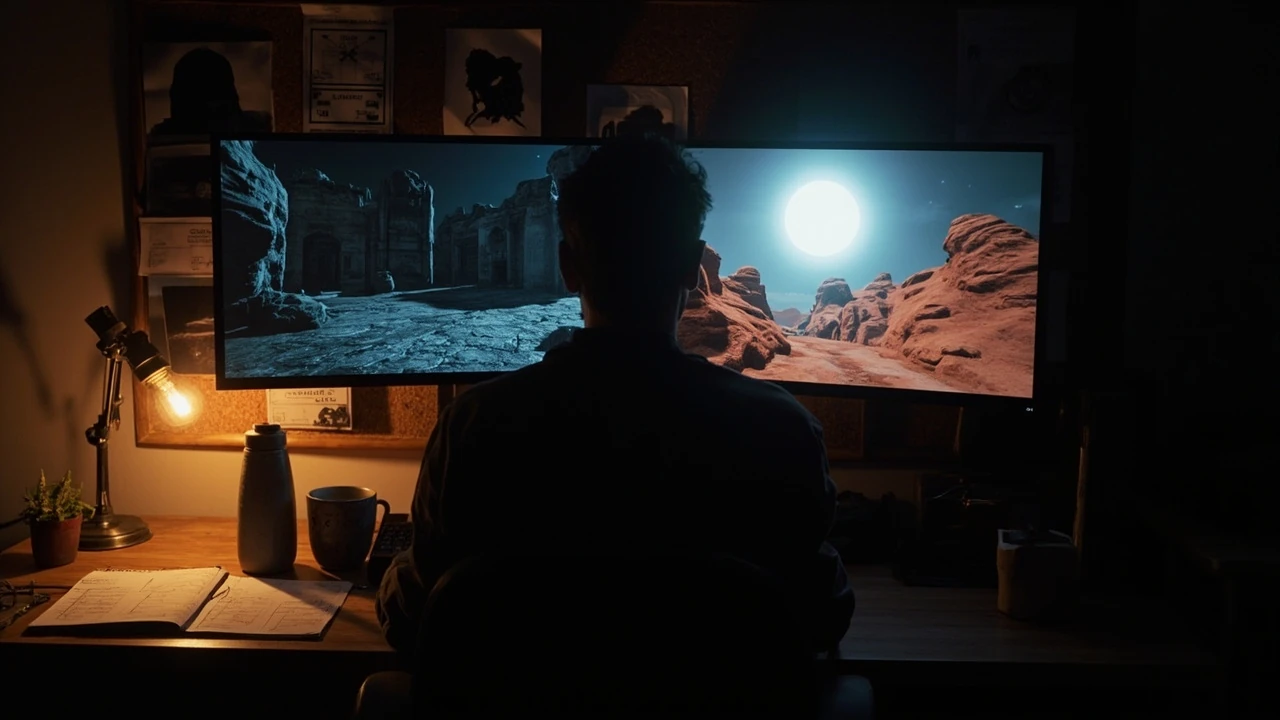
Players searching for the duskwood puzzle crimson desert crossover usually arrive with a concrete question: how do the two games’ puzzle systems actually meet, and which title’s rules govern the shared event? The event pairs Everbyte’s narrative adventure Duskwood with Pearl Abyss’s open-world action RPG Crimson Desert for a limited window, layering Duskwood’s investigation logic on top of Crimson Desert’s field-object interaction model. The crossover is small in scope, but it exposes several design decisions worth studying, from how a clue inventory is reconciled with a real-time combat economy to how a shared reward tier is balanced across two very different progression curves.
This article treats the event as a design artifact rather than a marketing tie-in. The goal is to walk through what each game contributes, where the two systems had to be adapted to talk to each other, and what a developer can learn from a collaboration that asks a slow-burn narrative detective game to share space with an open-world combat title. If you are only looking for a quick path through the puzzles, the Wikipedia entry on Crimson Desert is a reasonable starting reference, and the hands-on Crimson Desert review covers the base game’s moment-to-moment feel.
Duskwood puzzle crimson desert: what the crossover actually does
The duskwood puzzle crimson desert event is a limited-time cooperation between two studios that normally target very different sessions. Duskwood is a first-person mobile and PC narrative adventure built around message threads, photo evidence, and slow community-style deduction. Crimson Desert is an open-world action RPG with real-time melee, mounted traversal, and field-object puzzles that lean on physical interaction in a continuous world. The event asks the player’s Crimson Desert client to host a Duskwood-style clue board that feeds back into small, real-time puzzle encounters in the desert region of Demeniss.
Mechanically, the crossover is not a full port of one game into the other. Players do not play Duskwood inside Crimson Desert’s engine, and they do not receive a Duskwood chapter. Instead, the event imports a streamlined version of Duskwood’s clue logic: a list of evidence items, a small set of relations between them, and a single canonical solution per puzzle. The player’s Crimson Desert avatar then resolves that solution through field interactions, such as aligning mirrors, rotating statues, or activating ancient mechanisms, that already exist in the base game. The result is a thin layer of detective logic on top of Crimson Desert’s existing puzzle vocabulary.
For developers, the interesting question is not whether the crossover is “good” but how two systems with different cadences meet at all. A Duskwood clue board rewards players who stop, reread, and compare items; a Crimson Desert encounter punishes players who stand still in a contested zone. The event reconciles these by giving the clue phase a separate, instanced pocket of the world and by reducing the open-world risk during puzzle resolution. The choice is small but deliberate, and it sets the tone for every design decision in the event.
It is also worth saying what the event is not. It is not a new region, not a story chapter, and not a balance patch. The crossover content is gated behind a small notice in Demeniss, runs alongside the base game without modifying it, and disappears when the event window closes. The two studios did not retune enemy density, did not introduce a new mount, and did not ship a separate client. They shipped a single patch to Crimson Desert with an embedded clue interface and three field arenas, plus a small entitlement service that talks to Duskwood’s account system. That scope is what makes the event readable as a case study rather than as a typical seasonal update.
How the two games’ puzzle systems differ before the event
Understanding the duskwood puzzle crimson desert collaboration requires a working mental model of each title’s native puzzle design. The two systems were not built to interoperate, so the event’s compromises only make sense once the underlying approaches are visible.
| Dimension | Duskwood (base game) | Crimson Desert (base game) |
|---|---|---|
| Session length per puzzle | 15 to 45 minutes of reading and cross-checking | 1 to 5 minutes of in-world interaction |
| Core input | Tap or click on a clue, compare against a journal | Move, aim, swing, or place an object in the world |
| Failure state | Soft: wrong deduction, no progress, no punishment | Hard: enemy spawn, damage, or wasted time in combat zones |
| Reward type | Narrative advancement, new dialogue branches | Loot, crafting materials, regional reputation |
| Puzzle persistence | Purely client-side state, no server cost during solving | Authoritative server, persists across sessions |
| Pacing trigger | Player-driven, no timer | World-driven, enemy patrols and day-night cycle |
| Replay value | Low; each clue set is a one-shot | Medium; some arenas can be re-run for materials |
The single most important difference is what a “wrong answer” costs. Duskwood’s system is forgiving by design because the experience is about thinking through a story; Crimson Desert’s system is unforgiving by design because the experience is about surviving a world that pushes back. The duskwood puzzle crimson desert event had to pick one model for failure handling, and the developers chose Duskwood’s softer approach for the clue phase and Crimson Desert’s authoritative model for the resolution phase. That split is the most useful detail in the collaboration, because it shows where the seams are.
A secondary difference is the role of the camera. Duskwood’s puzzles live in a 2D evidence grid where the player zooms, pans, and reads at their own speed. Crimson Desert’s puzzles live in a 3D space where the camera is a first-person or over-the-shoulder view tied to the player’s avatar. The event’s interface has to bridge that gap, and the bridge is an overlay rather than a replacement view. The player still sees Demeniss behind a translucent panel, which is a small but deliberate signal that the clue phase is happening inside Crimson Desert’s world rather than in a separate app.
The shared clue board and how it behaves
The first thing the player sees in the duskwood puzzle crimson desert event is a small notice board in Demeniss that opens a Duskwood-style interface. From a design perspective this interface is the heart of the event. It is also the part that required the most adaptation, because Duskwood’s clue boards normally live inside a dedicated app surface and Crimson Desert’s UI has to overlay an active 3D world.
The board presents three to five clues per puzzle. Each clue is a stylized evidence item: a torn map fragment, a coded letter, a pressed flower, a sketch of a constellation. The player can drag clues into relation slots, where the system checks whether the pairing matches the canonical solution. The interface is intentionally minimal. It does not include a search function, a hint timer, or any kind of difficulty slider. The goal is to reproduce Duskwood’s slow-pace reasoning without dragging Crimson Desert players out of the world for too long.
Behind the scenes, the clue board is a constrained relational system. Each clue has a small set of allowed pairings, and the canonical solution is the unique combination that satisfies every relation. From a developer’s perspective, this is the same shape as a small constraint satisfaction problem. The event uses a deterministic solver on the server side to validate combinations, and the client only sends the player’s proposed relations as a graph, not as a free-form string. That choice has three consequences worth understanding:
- The server can reject an invalid solution instantly without parsing arbitrary input, which keeps the event safe from prompt-style exploits and from simple copy-paste sharing of solutions.
- Adding a new puzzle means authoring clues, relations, and a canonical graph on the server, not changing the client. This keeps client updates optional during the event window.
- The clue board cannot ask “why” a relation is correct. It can only confirm or deny a pairing, so narrative context has to come from a short caption on each clue, not from the puzzle engine itself.
This design is also why the event feels closer to Duskwood than to Crimson Desert in its first minute. The clue board deliberately strips away combat, traversal, and threat, and asks the player to slow down and think. For Crimson Desert players who never played Duskwood, the clue board is the most foreign part of the collaboration, and it is also the part that the event is built around.
There is one more detail that the on-screen surface hides. Each clue carries a localization key, a short caption, and a small icon set. The captions are written by Everbyte in a tone that matches Duskwood’s investigation files: dry, observational, and slightly literary. Pearl Abyss ships the captions as a localization bundle, and the rest of the clue board uses Crimson Desert’s normal text rendering. The split matters because it means the writing voice of the event is consistent with Duskwood even when the surrounding chrome is Crimson Desert. A developer reading the captions in isolation could place them in Duskwood without changing a word.
Field puzzles: where Crimson Desert’s vocabulary takes over
Once the player has identified the correct relations on the clue board, the second phase of the duskwood puzzle crimson desert event begins. The player’s Crimson Desert avatar receives a marker on the map pointing to a small arena in Demeniss. The arena contains a physical puzzle built from the base game’s existing interaction vocabulary: reflective surfaces, pressure plates, timed switches, and rotating statues. The clue board’s solution decides what the player has to do in the arena, but the arena itself uses Crimson Desert’s normal rules for interaction, timing, and failure.
There are three canonical field puzzle shapes in the event. Each is built from primitives that already exist in Crimson Desert, which is one of the most useful design decisions in the collaboration. The developers did not invent new puzzle primitives. They recombined existing ones.
| Field puzzle | Clue board output | Crimson Desert primitives used |
|---|---|---|
| Mirror alignment | Map fragment + constellation sketch | Rotatable mirrors, light beam receivers, day-night cycle |
| Sealed door sequence | Coded letter + pressed flower | Pressure plates, timed switches, order-sensitive triggers |
| Statue rotation | Three clue pairings pointing to cardinal directions | Heavy objects, rotation gizmo, hostile NPC spawns on error |
The third row is the most interesting. The statue rotation puzzle spawns a small group of hostiles if the player rotates a statue in the wrong direction, which is a direct import of Crimson Desert’s failure state into a puzzle that Duskwood’s system would normally treat as soft. The duskwood puzzle crimson desert team chose to keep that penalty because the field phase is fully under Crimson Desert’s authority, and Crimson Desert’s design treats most physical puzzles as reversible but costly. The compromise is that the hostiles are tuned to be survivable without combat gear, so a player who is still wearing exploration equipment can still finish the puzzle.
From a developer’s perspective, the field puzzle layer is the part that most directly answers the question of how a slow, narrative puzzle can fit into a real-time world. The answer is: it cannot fully fit, and the event admits that. The clue board is the part that respects Duskwood’s pacing, and the field puzzles are the part that respects Crimson Desert’s world. The seam between them is a single teleport and a brief loading screen, and that seam is honest about the fact that two design philosophies are meeting.
It is also worth noting how the arenas are placed. Each arena is tucked into a side canyon or a ruin pocket in Demeniss, away from the main road and away from the densest enemy patrols. The placement is not accidental. A field arena that sits in a high-traffic combat zone would have forced the player to clear enemies before reading the clue board’s results, which would have collapsed the two phases into a single combat encounter. By placing the arenas in low-traffic pockets, the developers preserved the clue board’s quiet pacing as a real option rather than a nominal one.
Reward structure and the progression problem
Reward design is where most crossovers between asymmetric games struggle, and the duskwood puzzle crimson desert event is no exception. The two games measure progress very differently. Duskwood advances through story chapters and community clues. Crimson Desert advances through gear score, regional reputation, and crafting material stockpiles. A reward that is meaningful in one system is often invisible in the other.
The event resolves this with a layered reward table. Completing a clue board unlocks a small cosmetic item, a profile banner, and a single line of flavor text that is visible in both games. Completing a field puzzle unlocks a region-specific crafting material and a small amount of regional reputation. Completing both unlocks a mount skin in Crimson Desert and a decorative journal cover in Duskwood. The pattern is intentional: each game’s players see the reward that is meaningful in their system, and the cosmetic crossover is layered on top rather than replacing either.
Developers studying this approach should pay attention to three details:
- Each game retains ownership of its native reward surface. The crossover does not insert Crimson Desert gear into Duskwood’s story, and it does not insert Duskwood chapters into Crimson Desert’s world.
- The shared cosmetic is delivered through a single cross-game account link, which is the only piece of infrastructure the event actually needs beyond the clue board and the field puzzles.
- Reward scaling is flat. There is no difficulty tier, no daily reset, and no grind loop. Players who complete the event once have seen all the content, and players who do not engage with it are not punished.
The flat scaling is the most defensible choice in the collaboration. A grind loop would have forced Duskwood’s slow pace into a daily login, and a difficulty tier would have forced Crimson Desert’s combat loop into a story context. By keeping the rewards flat and the content finite, the duskwood puzzle crimson desert event keeps its identity as a design experiment rather than a live-service commitment.
There is also a small economic decision behind the reward table. The region-specific crafting material in Crimson Desert is tuned to be roughly equivalent to one mid-tier node harvest in Demeniss. That is enough to matter to a new player without trivializing the material economy for veteran players. The designers deliberately avoided making the crossover material the most efficient way to acquire a specific component, because a reward that breaks the economy is the fastest way to alienate the player base that did not ask for the crossover in the first place.
Failure handling and the seam between systems
Failure handling is the part of the duskwood puzzle crimson desert event that exposes the most about how the two systems were joined. There are three failure points worth examining, and each one is a different design problem.
- Wrong clue pairing. The clue board returns a soft error, the player keeps the clues, and the canonical solution is unchanged. This matches Duskwood’s native behavior and is the cleanest part of the event.
- Wrong field puzzle action. The arena spawns a small hostile group, the player can retry the puzzle, and there is no durability cost. This is a softened version of Crimson Desert’s normal failure, and it is a deliberate concession to Duskwood’s players.
- Player logout during the field phase. The event persists the player’s clue board state and the field puzzle progress independently. Logging out and back in restores both, but the field puzzle’s hostile spawns are reset. This is the most interesting compromise, because it is a hybrid of the two systems’ persistence models.
The third point is the one that matters most for developers. Duskwood’s clue board is normally a client-side experience, and Crimson Desert’s field puzzles are normally authoritative on the server, with a strict state model that does not tolerate partial progress across sessions. The event makes the clue board authoritative on the server and the field puzzle authoritative on the server, but it persists them as two separate state objects. If the player loses connection during the field phase, the clue board is not rolled back, and the field puzzle is reset to the moment before the failure. That split state is the only honest way to keep both systems’ persistence rules intact.
There is one failure case the event does not handle, and that absence is also instructive. If the player’s Crimson Desert client crashes during a field arena, the arena resets and the hostiles respawn, but the clue board does not advance. A player who rage-quits a difficult statue rotation will find themselves back at the same relation screen they were at ten seconds earlier. That choice protects the clue board’s integrity at the cost of a small amount of frustration, and the duskwood puzzle crimson desert team accepted that trade because the alternative would have been to either auto-complete the field puzzle or to invalidate the clue board, both of which would have broken the event’s two-phase shape.
Production decisions behind the collaboration
From a production standpoint, the duskwood puzzle crimson desert event is a useful case study in how to scope a crossover without inflating it. The event shipped with a small, fixed content set: three clue board puzzles, three field arenas, and a single shared reward track. There is no live event calendar, no seasonal refresh, and no roadmap for new puzzles during the event window. The decision to keep the content finite is itself a production decision, and it is worth analyzing.
First, the fixed content set lets both studios keep their content pipelines separate. Everbyte authors clue boards, relations, and clue captions. Pearl Abyss authors the field arenas, the hostile spawns, and the reward integration. Neither studio has to learn the other’s engine or toolchain. The only shared artifact is a JSON-shaped relation graph and a small set of localization strings, and both of those are reviewable without an engine build.
Second, the fixed content set removes the need for an event manager role. A live service event usually requires someone to monitor player behavior, respond to bugs, and approve content drops. A finite event can be shipped and left alone, which is the only realistic scope for a collaboration between two studios that are not merging their live operations.
| Production area | Owned by Everbyte | Owned by Pearl Abyss |
|---|---|---|
| Clue board UI | Yes | No |
| Field arenas | No | Yes |
| Clue graph data | Yes | No |
| Reward integration | Cosmetic only | Crafting and reputation |
| Cross-game account link | Shared | Shared |
| Localization review | Clue captions | Arena text, banner text |
| QA matrix | Clue solver edge cases | Field arena state transitions |
The shared account link is the only piece of cross-team infrastructure in the entire event, and even that is a thin layer. It is an account identifier, a small entitlement list, and a callback URL. The two clients each poll their own entitlement endpoint, and neither has to know the other’s authentication system. That decoupling is what makes the event small enough to ship in a single patch cycle.
Third, the fixed content set lets the QA process be split cleanly. Everbyte’s QA covers the clue solver, the relation graph, and the caption rendering. Pearl Abyss’s QA covers the field arenas, the hostile spawns, and the reward delivery. The only shared QA concern is the entitlement handoff, which is small enough to test in a sandbox account. A larger event would have required a shared QA matrix, a shared staging environment, and a shared localization pass. The duskwood puzzle crimson desert event avoids all three by keeping the content small enough to test in isolation.
What developers can reuse from the design
Studying the duskwood puzzle crimson desert event is most useful when the takeaways translate to other collaborations. Three patterns from the event are worth carrying into other projects.
- Keep each system authoritative in its own domain. The event does not try to merge Duskwood’s clue board into Crimson Desert’s world simulation. It keeps the clue board authoritative on the server and the field puzzles authoritative in the world, and the seam is a single teleport.
- Use existing primitives rather than new ones. The field puzzles are built from Crimson Desert’s mirror, pressure plate, and rotation systems. There are no new interaction types, no new animation sets, and no new UI surfaces beyond the clue board.
- Treat rewards as a translation layer. Each game keeps its native reward surface, and the shared cosmetic is layered on top. A collaboration does not have to merge progression systems to feel meaningful, and trying to merge them is the most common cause of a crossover feeling forced.
These are not new ideas in game design, but the duskwood puzzle crimson desert event applies them in a small, contained space. That is what makes it a useful reference: it is short enough to read in an afternoon, narrow enough to study in detail, and honest enough about its seams to be instructive rather than aspirational.
A fourth pattern is worth mentioning even though it is not about the puzzle layer: the event treats scope as a deliverable. The team chose to ship three puzzles and three arenas, not a roadmap for ten. That choice is a production pattern as much as a design pattern, and it is the part of the collaboration that is hardest to copy. Most teams that try to design a crossover start with a long content list and a short timeline. The duskwood puzzle crimson desert team started with a short content list and a long timeline, and the result is a collaboration that actually shipped.
Limitations of the event as a design reference
It is worth being explicit about the limits of what the duskwood puzzle crimson desert collaboration can teach. The event is small, finite, and asymmetric in a way that many crossovers are not. A few caveats are important for developers who want to lift patterns from it.
First, the event is built around a one-way influence: Duskwood’s clue logic is imported into Crimson Desert’s world, but not the other way around. A crossover that has to move design elements in both directions at once faces a much harder integration problem, and the patterns from this event do not generalize cleanly to that case. A two-way import would require both studios to author content in the other’s puzzle vocabulary, and the seam between systems would have to carry traffic in both directions instead of one.
Second, the event’s reward model is flat by choice, not by necessity. A live service collaboration with daily engagement, a season pass, or a battle pass has to solve a different reward scaling problem, and the flat structure of the duskwood puzzle crimson desert event does not address that. A team planning a longer collaboration should not assume that a flat reward table will work in a live service context.
Third, the event is small enough that it does not need a dedicated QA matrix. A team that scales the same pattern to a larger event, with more puzzles, more arenas, and a longer window, will have to invest in cross-game QA, localization parity, and entitlement testing that the duskwood puzzle crimson desert team did not have to build.
Fourth, the event assumes a particular ratio of players: most participants arrive from Crimson Desert’s player base, and a minority arrive from Duskwood’s. The clue board’s pacing is tuned to that ratio. A collaboration between two titles with a more even player split would have to decide which audience’s pacing to honor, and the duskwood puzzle crimson desert event’s choice would not transfer cleanly.
How the event fits into a wider GameDev reading list
For developers who want to keep reading, the most useful adjacent pieces on this site are two very different references. The first is a long-form field guide to a familiar game’s design decisions, which is a good counterweight to the small, contained scope of the duskwood puzzle crimson desert event. The Resident Evil 4 walkthrough page is exactly that kind of reference: it treats a finished game as a design artifact and walks through the systems decisions in order. The second is a comparison between two graphics settings on a real GPU, which is useful for any developer who has to ship a build that runs on hardware that is older than the latest generation. The GeForce RTX 2070 DLSS 4.5 vs DLSS 5 page is a short, practical reference for that kind of decision.
Frequently asked questions
What is the duskwood puzzle crimson desert event?
It is a limited-time collaboration between Duskwood, a narrative adventure game by Everbyte, and Crimson Desert, an open-world action RPG by Pearl Abyss. The event layers a Duskwood-style clue board on top of small field puzzles in Crimson Desert’s desert region of Demeniss. Players solve a relational clue graph and then complete a matching arena puzzle using Crimson Desert’s existing interaction vocabulary.
Do players need to own both games to take part?
Ownership and account requirements are set by each platform holder and can vary by region and event window. The event’s design only assumes that the player has access to Crimson Desert’s client and a linked cross-game account. Players who do not have a Duskwood account can still complete the clue boards, because the interface is hosted inside Crimson Desert’s client during the event.
How long is the duskwood puzzle crimson desert event available?
The event’s content set is finite and short, typically a few weeks, but the exact window is set by the publishers and is subject to change. Players should check the in-game notice in Crimson Desert for the current end date rather than relying on a date from a guide.
Are the puzzles the same for every player?
Yes. The clue board and the field arenas have a single canonical solution per puzzle, and the server validates the player’s relations against that solution. There is no procedural variation, no random seed, and no daily reset, which is one of the event’s main design choices.
What rewards does the event give?
Completing a clue board gives a cosmetic item, a profile banner, and a line of flavor text visible in both games. Completing a field arena gives a region-specific crafting material and a small amount of regional reputation. Completing both gives a mount skin in Crimson Desert and a decorative journal cover in Duskwood.
Can players share solutions with each other?
Sharing a written solution is possible but not very useful, because the clue board validates a player’s proposed pairings against the server rather than against a client-side string. The most useful kind of help is a hint that points to a relation, not a copy-pasted answer, and the event’s designers have stated that hint-style help is the intended sharing model.
What happens if a player logs out during a field puzzle?
The clue board state and the field puzzle state are persisted independently. The clue board is restored exactly as it was, while the field puzzle resets to the moment before the failure. The player can retry the arena without losing clue progress.
Is the event a good introduction to Duskwood?
It is a reasonable first taste of Duskwood’s clue logic, but it is not a substitute for the base game. The event’s clue boards are intentionally small and have no narrative context, so a player who enjoys the crossover will still want to play Duskwood for the full story experience.
What engine and networking model does the event use?
The event uses Crimson Desert’s existing client and server stack, with a small additional service for cross-game entitlements. Duskwood’s clue board is rendered as an overlay inside Crimson Desert’s client, and the relational graph is validated on a dedicated server endpoint. There is no peer-to-peer component.
Will the event return in future seasons?
Both studios have described the event as a finite collaboration rather than a recurring live service, and there is no public roadmap for a return. Players who want to see the content should treat the current window as the only confirmed opportunity.

Leave a Reply