
GeForce RTX 2070 SUPER DLSS 5 compatibility
NVIDIA has announced no official DLSS 5 support for the GeForce RTX 2070 SUPER and has not committed to a future driver or SDK path. The desktop Turing card does not meet the newer Tensor Core and optical-flow contracts used at launch.
Studios can set their minimum specification now, and owners can judge an upgrade without waiting for a promised clarification that does not exist.
The supported path on this GPU is DLSS 4.5 Super Resolution and Ray Reconstruction. Launch chatter about later legacy patches and modded unlocks does not change that. Neither a renamed plugin control nor an unsupported driver can supply hardware the TU104 die lacks.
The hardware shipped in the RTX 20 series
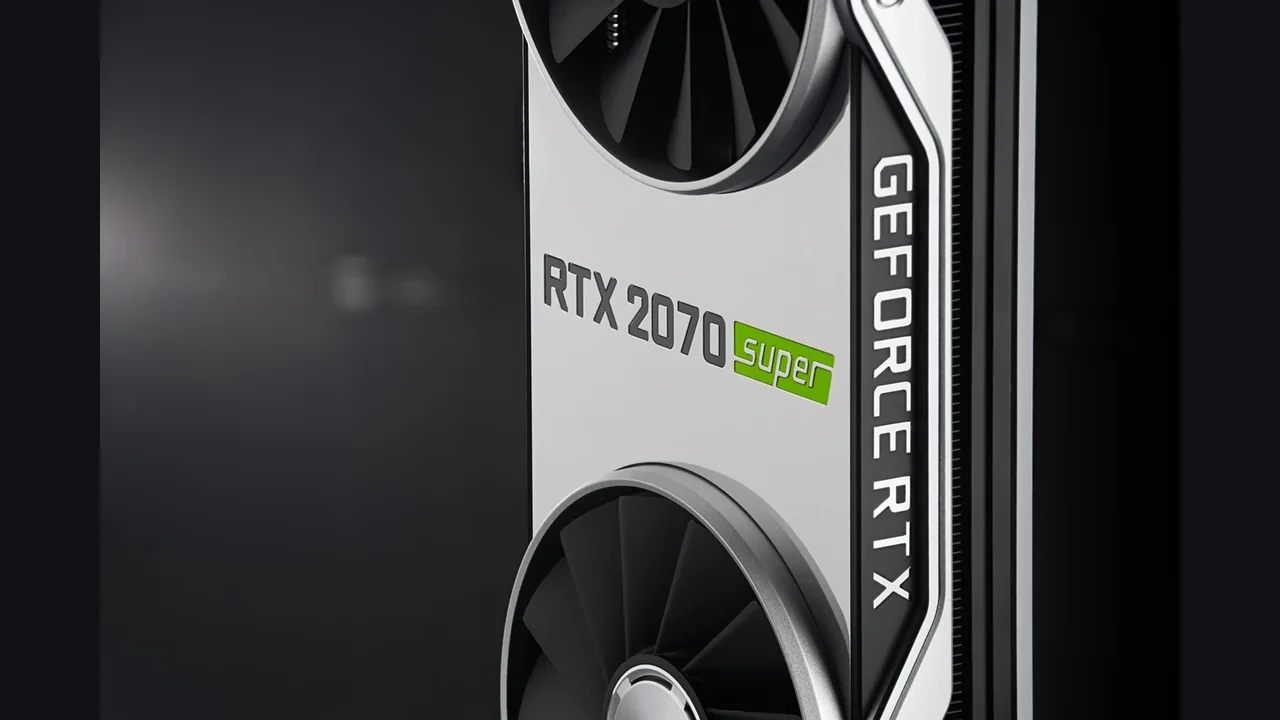
The GeForce RTX 2070 SUPER is a TU104 desktop card from 2019 and part of the Turing-based RTX 20 series. NVIDIA made early DLSS 1.x and 2.x versions broadly available across RTX hardware, but later releases added requirements tied to Tensor Core capability, driver branches, and engine SDK updates.
DLSS consists of separate Super Resolution, Frame Generation, and Ray Reconstruction modules, each with its own minimum contract.
The RTX 20 family introduced hardware ray tracing and third-generation Tensor Cores. Those Tensor Cores handle the convolution-heavy upscaling and frame-interpolation work behind DLSS. If a new path needs low-precision matrix instructions or throughput beyond Turing’s range, loading the driver is not enough to produce acceptable quality.
Engines query NGX and the Streamline / DLSS plugin before showing a mode. If the runtime rejects the adapter, the game must use an older DLSS branch or a non-DLSS upscaler. Frame Generation follows the same rule and never reaches its entry point on an unrecognized GPU.
How DLSS versions map to features
Marketing numbers bundle several technical modules. Developers should gate the feature itself rather than assume the version name gives one answer for every GPU.
- DLSS 1.x: a spatial upscaler trained per title, with limited adoption on early RTX 20 driver branches.
- DLSS 2.x: a temporal upscaler using one network across many games, with broad support that includes the RTX 2070 SUPER.
- DLSS 3: the release that introduced Frame Generation and its optical-flow requirement, initially a flagship RTX 40 feature.
- DLSS 3.5: the addition of Ray Reconstruction for better ray-traced denoising on hardware that met the required path.
- DLSS 4 and 4.5: further Super Resolution, Frame Generation, and Ray Reconstruction updates on newer supported tiers.
NVIDIA has generally kept Super Resolution and Ray Reconstruction available on RTX hardware with a suitable Tensor path. Frame Generation has remained the stronger cutoff, and newer releases can add Tensor-specific modes that older silicon cannot accelerate efficiently.
NVIDIA’s DLSS 5 launch position for the RTX 2070 SUPER
At the launch window of 3 September 2026 at 21:00 PT, NVIDIA had not announced support for the GeForce RTX 2070 SUPER. There was no day-one driver, no DLSS 5 plugin SDK entry targeting TU104, and no compatibility list containing the card.
That statement covers both Super Resolution and Frame Generation. Its status remains “not officially supported” unless NVIDIA publishes a change.
NVIDIA’s research and developer-relations material names supported adapters, recommended drivers, and feature-level gates. Its current focus is the RTX 40 and RTX 50 series. The RTX 20 family does not appear in the DLSS 5 adapter list, and the SDK documentation follows the same boundary.
The GeForce RTX 2070 SUPER instead remains on DLSS 4.5 Super Resolution and Ray Reconstruction. Frame Generation has never been officially enabled on it. Studios and players can use the GeForce 20 series reference to place the RTX 2070 SUPER in its hardware family, then work from the published support state rather than a possible future update.
Current feature coverage
This table compares the verified DLSS 4.5 modules with the unavailable DLSS 5 paths.
| Feature module | DLSS 4.5 status on RTX 2070 SUPER | DLSS 5 status on RTX 2070 SUPER | Notes for engine integration |
|---|---|---|---|
| Super Resolution (upscaling) | Officially supported | No official launch support | Falls back to DLSS 4.5 path |
| Ray Reconstruction | Officially supported | No official launch support | RTX ray-traced denoising remains on DLSS 4.5 |
| Frame Generation | Not officially supported | No official launch support | Optical flow path not exposed on RTX 20 series |
| DLSS 5 new model modes | N/A | No official launch support | Mode list does not list the adapter |
A game that makes DLSS 5 its minimum feature cannot use that same floor for the RTX 2070 SUPER. It needs a separate DLSS 4.5 tier.
Why the RTX 2070 SUPER stays on the older path
NVIDIA’s cutoff reflects Tensor instructions, optical-flow bandwidth, and memory-system characteristics absent from Turing. Even similar math can miss the throughput or image-quality target on a TU104 die at normal desktop clocks. The DLSS 5 SDK therefore returns false for the adapter and withholds the path.
The plugin can still load, much like a newer console SDK might run while selecting an older renderer for previous hardware. On the RTX 2070 SUPER, it returns the DLSS 4.5 path because NVIDIA has not validated the new model there. A forced flag or modded plugin can change a menu, but it cannot create the required Tensor and optical-flow units.
A studio can keep the card in its supported list while advertising DLSS 5 only on newer tiers. The accurate minimum entry is “DLSS 4.5 Super Resolution and Ray Reconstruction, no DLSS 5, no Frame Generation.”
What changes from DLSS 4.5 to DLSS 5
NVIDIA’s launch material describes an updated Super Resolution model, a revised Ray Reconstruction path, and broader Frame Generation refinements for supported adapters. The goal is higher quality and stability on GPUs that can run the model, with the highest presets centered on the RTX 40 and RTX 50 series.
The RTX 2070 SUPER ran DLSS 2.x well and currently supports DLSS 4.5 Super Resolution and Ray Reconstruction. Its visible gap is Frame Generation, which never received an RTX 20 path. If NVIDIA broadens the DLSS 5 list, optical-flow requirements are likely to remain the gating feature.
DLSS 5 also changes training distribution and its feature map, giving the SDK different latency and image-quality trade-offs. The application can query a per-mode quality table. On an unsupported adapter, it receives the legacy mode table and follows the “no DLSS 5” branch, which runs DLSS 4.5 instead.
Checking support inside a game or engine
- Load the latest DLSS 5 plugin and query Super Resolution, Ray Reconstruction, and Frame Generation for the active adapter.
- Compare the adapter tier with the official DLSS 5 list. A GeForce RTX 2070 SUPER returns “legacy path” for all three modules.
- Query DLSS 4.5 on the same card. It returns “supported” for Super Resolution and Ray Reconstruction and “not supported” for Frame Generation.
- Log the response and route quality settings to the legacy path. Do not display DLSS 5 controls on this tier.
- Confirm the active renderer with the in-engine DLSS overlay or a third-party frame capture.
Players can check the driver version and graphics menu. A menu offering DLSS Quality, Balanced, Performance, and DLAA but no DLSS 5 indicates the legacy path. A greyed DLSS 5 option marked “supported adapter required” means the same thing.
For a strong QA sanity check, run the same driver and plugin on a known RTX 40 or RTX 50 card. If the RTX 2070 SUPER reports “legacy path” and the newer GPU reports “DLSS 5 supported,” the SDK is behaving as documented.
Operational guidance for game teams and players
For studios shipping a DLSS 5 game
- Use “DLSS 4.5 Super Resolution and Ray Reconstruction” for the RTX 20 tier, and reserve “DLSS 5” for supported RTX 40 and RTX 50 tiers.
- When the DLSS 5 query fails, show working DLSS 4.5 modes instead of an error or dead control.
- Validate image quality, render scale, and input latency on a real RTX 2070 SUPER rather than a faster substitute.
- State the tier difference plainly in the public specification to avoid predictable support tickets.
- Pin the DLSS plugin so every QA system reproduces the same legacy behavior.
- Monitor the SDK changelog after launch and reevaluate the minimum floor if NVIDIA revises the adapter list.
For GeForce RTX 2070 SUPER owners
- Treat the card as “legacy path only” unless NVIDIA explicitly changes its position.
- Keep the Studio or Game Ready driver current because DLSS 4.5 image quality can still improve through those updates.
- Avoid modded “DLSS 5 unlock” plugins. They cannot provide the real TU104-incompatible path and may destabilize other rendering features.
- If Frame Generation is required for a game, plan for an RTX 40 or RTX 50 card with official support.
- Use DLSS 4.5 Quality or Balanced for most 1440p workloads and Performance for 4K. Many current games still leave the card comfortable in those modes.
How long DLSS 4.5 should remain useful
DLSS 4.5 is a stable target for the RTX 2070 SUPER through any current release cycle. NVIDIA does not normally remove a supported generation from a card mid-cycle, and both Super Resolution and Ray Reconstruction are mature paths with several quality modes. The larger risk is that future games rely on DLSS 5 features that have no DLSS 4.5 equivalent, such as Frame Generation refinements needing newer optical-flow work.
For at least one more major release cycle, studios can reasonably plan an RTX 20 tier with DLSS 4.5 and an RTX 40 or later tier with DLSS 5. If Frame Generation is mandatory, raise the minimum GPU to RTX 40.
Signals that would change the status
- NVIDIA publishes an adapter list including RTX 20 hardware and a matching driver or SDK that exposes DLSS 5 model modes on TU104.
- An official SDK changelog enables DLSS 5 Super Resolution on legacy adapters under a relaxed Tensor Core contract.
- A Streamline plugin lists the GeForce RTX 2070 SUPER as supported for any of the three DLSS 5 modules.
None had appeared during the launch window. Until one does, DLSS 5 remains unsupported and DLSS 4.5 remains the stable path. The RTX 20 series reference documents the 2019 release window, TU104 silicon, and family context behind that boundary.
Verified decision table
The day-one answer is simple: the RTX 2070 SUPER stays on DLSS 4.5 Super Resolution and Ray Reconstruction, with no official Frame Generation or DLSS 5 support.
| Question | Verified answer for GeForce RTX 2070 SUPER |
|---|---|
| Is the GeForce RTX 2070 SUPER on the DLSS 5 supported adapter list? | No. It is not in the day-one supported list. |
| Will DLSS 5 be added in a later driver? | No commitment has been announced. |
| What is the current official DLSS version for this card? | DLSS 4.5, including Super Resolution and Ray Reconstruction. |
| Does the card support frame generation? | Frame generation has never been officially enabled on the RTX 20 series. |
| What should studios set as the minimum spec on this tier? | DLSS 4.5 Super Resolution and Ray Reconstruction, no DLSS 5, no frame generation. |
| What should players do today? | Keep the driver current, use DLSS 4.5 modes, plan a hardware upgrade if frame generation is a hard requirement. |
Frequently asked questions
Does the GeForce RTX 2070 SUPER support DLSS 5 at launch?
No. It is absent from the day-one list, and NVIDIA has not announced a later driver or SDK addition. DLSS 4.5 Super Resolution and Ray Reconstruction remain current, while Frame Generation has never been officially supported on RTX 20.
What is the latest official DLSS version available on the RTX 2070 SUPER?
DLSS 4.5, including Super Resolution and Ray Reconstruction. Driver updates can refine those modules, but they do not add the day-one DLSS 5 path.
Can the RTX 2070 SUPER run DLSS 5 with a modded driver or plug-in?
No. The real path depends on Tensor instructions and optical-flow capability absent from the card. A mod can rename an option or load a stub, but it cannot deliver the actual model or Frame Generation and may destabilize other rendering paths.
Why is the RTX 2070 SUPER not on the DLSS 5 supported list?
The DLSS 5 Tensor Core and optical-flow contract is beyond Turing. NVIDIA has not validated the model on TU104, so the SDK returns the legacy path. The boundary is technical rather than commercial.
Will NVIDIA add DLSS 5 support to the RTX 2070 SUPER later?
NVIDIA has made no commitment. A change would appear in the DLSS SDK changelog and supported-adapter page.
Does the RTX 2070 SUPER support DLSS frame generation?
No. Frame Generation arrived with DLSS 3 and launched on RTX 40 desktop cards. NVIDIA never enabled it on RTX 20, so games should not advertise it for the RTX 2070 SUPER.
What is the realistic minimum spec for a DLSS 5 title on RTX 20 series hardware?
Use “RTX 20 series with DLSS 4.5 Super Resolution and Ray Reconstruction, no DLSS 5, no Frame Generation.” A title may keep RTX 20 support at that quality floor. If Frame Generation is mandatory, raise the minimum to RTX 40.
How can a developer verify DLSS 5 support on a specific machine?
Query Super Resolution, Ray Reconstruction, and Frame Generation through the DLSS 5 plugin, then compare the returned tier with NVIDIA’s adapter list. The RTX 2070 SUPER returns legacy for all three. Its DLSS 4.5 report returns supported for Super Resolution and Ray Reconstruction and unsupported for Frame Generation. NVIDIA’s research page provides the current adapter list.
How long will the DLSS 4.5 path remain useful on the RTX 2070 SUPER?
It is a stable target through any current release cycle. NVIDIA does not usually remove support mid-cycle, and the modules are mature. The risk is that new games adopt DLSS 5 features with no 4.5 equivalent, especially Frame Generation refinements.
Should a player on an RTX 2070 SUPER upgrade for DLSS 5?
Only if the unavailable features matter. If DLSS 4.5 Quality or Balanced already meets the resolution and refresh target, DLSS 5 alone is not an urgent reason. Frame Generation or the highest DLSS 5 presets require an RTX 40 or RTX 50 upgrade. Recheck NVIDIA’s list after each driver or SDK release before deciding.




Leave a Reply