
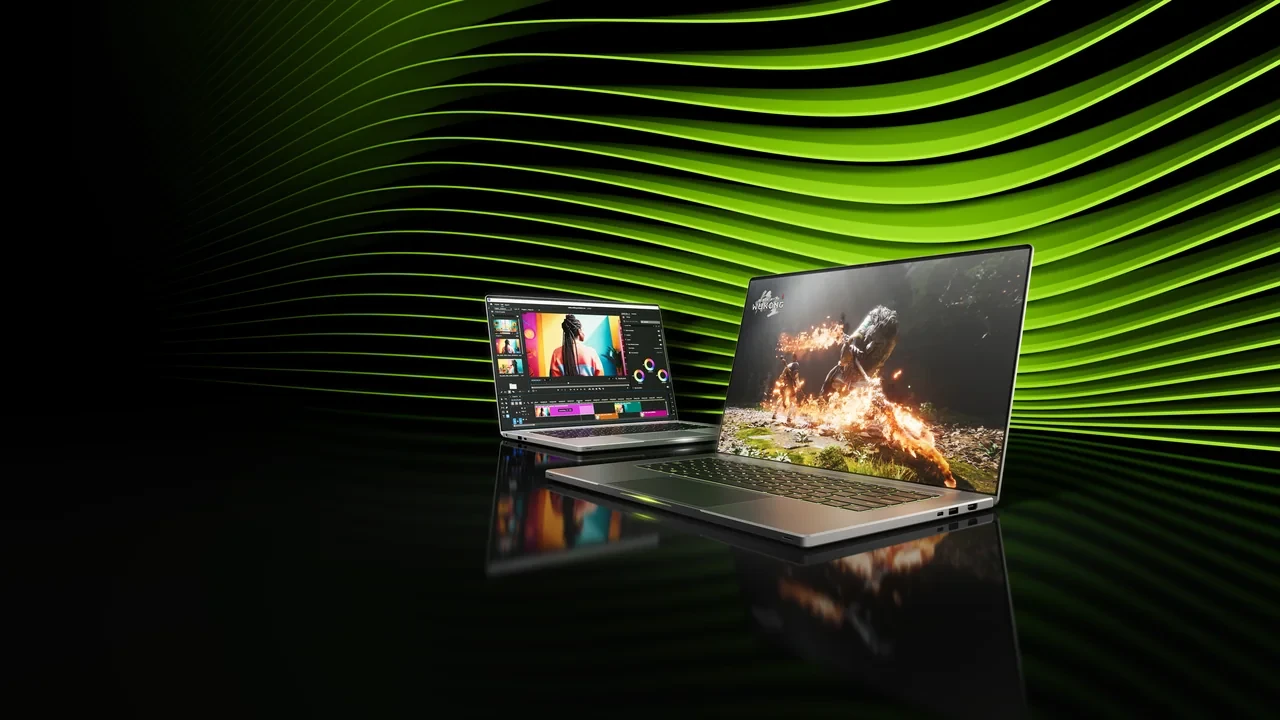
GeForce RTX 5060 Laptop GPU DLSS 5 best settings for GameDev work
The GeForce RTX 5060 Laptop GPU needs its own settings profile for image quality, latency, and power. The September 3, 2026 DLSS 5 launch changes the available feature set, but it does not make a mobile GPU behave like the desktop board carrying the same family name. GameDev engineers, technical artists, and producers should validate the laptop path before approving an in-engine review or QA build.
NVIDIA lists the GPU within the supported RTX 50 Series family, while public SDK and driver coverage remain gated to the release window. Benchmarking before the official runtime appears risks measuring a path the retail driver does not expose. Tune around the chassis power envelope and verify frame generation and Ray Reconstruction only after the public components are available.
Where the Profile Must Hold
The profile should survive vertical-slice reviews, on-site technical-art passes, thin-and-light QA, and post-mortems after thermally constrained trade-show demos. None can rely on a desktop power budget or a few seconds of peak boost.
The GPU belongs to the RTX 50 Series and shares its driver and SDK family. Production DLSS 5 support begins with the public launch. On the laptop itself, sustained power, thermals, and the OEM profile usually matter more than peak throughput.
What Remains Unverified
No chassis-specific review or pre-launch game benchmark is presented. Numerical claims must come from a public specification or be framed as targets that a profiler still needs to validate.
Why Desktop Presets Do Not Transfer
The GeForce RTX 5060 Laptop GPU and the desktop RTX 5060 share a generation and a marketing name, but they are not the same product. The laptop part lives inside a constrained power envelope, a fixed cooling solution, and a chassis that the OEM chose. A settings profile that ignores the laptop form factor will either over-promise on image quality or under-use hardware that the user has already paid for. Game developers who profile on a laptop and ship on a wider range of hardware need a clear picture of what changes when the same product line moves to a notebook.
Sustained Power and Thermal Limits
A laptop GPU is sold with a configurable total graphics power (TGP) range. The OEM selects a value inside that range based on the chassis, the cooling solution, and the marketing position of the laptop. Two laptops with the same GeForce RTX 5060 Laptop GPU can therefore sit at meaningfully different sustained power, which directly changes frame rate, fan curve, and surface temperature. A settings profile that works on one chassis can be too aggressive on a thinner build or too conservative on a thicker one.
From a GameDev point of view, the settings profile has to include a power check. Read the OEM’s TGP value out of the diagnostic tool that the driver exposes, then set the laptop to its highest sustained power profile. The settings stack that follows should be tuned against that profile, not against peak boost behavior that only lasts a few seconds.
Memory Bandwidth and VRAM Pressure
Laptop parts in the RTX 50 Series tend to land in the same VRAM tier as their desktop cousins, but the bus width and the memory clock are typically tuned for the laptop power budget. Texture streaming, ray-tracing acceleration structures, and DLSS feature buffers all read and write memory, and the laptop’s effective bandwidth is what sets the ceiling for the heaviest scenes. A developer profile has to budget VRAM and bandwidth before it picks a DLSS mode, because a heavy preset that looks fine on paper can stall on a frame that is bandwidth bound.
Display Path and Refresh Rate
Laptop panels are usually 1080p or 1600p, often with a high refresh rate and sometimes with G-SYNC or a variable refresh range tied to the dGPU path. Because DLSS 5 sits between the rendered frame and the display, the panel determines how much latency the upscaler can spend. A 60 Hz panel has a much larger per-frame budget than a 240 Hz panel. Ignore that difference and the profile may spend latency on frames the player never sees.
DLSS 5 Release Requirements
DLSS 5 is scheduled to launch as an RTX 50 Series feature, and the GeForce RTX 5060 Laptop GPU is officially part of that family. Public SDK access, reference drivers, and integration samples remain tied to the release window. Before it opens, support is an architectural statement rather than production confirmation.
Do not promise DLSS 5 in patch notes until the SDK is public. For a vertical slice, capture a baseline with the existing DLSS presets and repeat it under DLSS 5 once the SDK is available. Engine-level work can proceed against a preview, but the user-facing feature flag should remain gated to the launch date.
What RTX 50 Series Support Confirms
The RTX 50 Series is NVIDIA’s current GeForce generation, and the GeForce RTX 5060 Laptop GPU belongs to that family. The RTX 50 series page covers the launch context and the relationship between desktop and laptop parts. SDK and driver expectations align across the family; laptop power limits and OEM tuning do not.
DLSS 5 in the Existing Stack
DLSS 5 does not replace DLSS 4, DLSS 3.5, or earlier generations. It extends the upscaling and frame generation pipeline with new modes, and the GeForce RTX 5060 Laptop GPU is expected to support the same mode set as the wider RTX 50 Series family. NVIDIA’s DLSS 5 launch and compatibility publication describes the feature and supported devices. Use the SDK release notes, not a secondary write-up, when implementing a feature flag or settings UI.
What a Development Profile Must Balance
A development profile has different priorities from a player’s launch preset. It must balance image quality, latency, stability, and reproducibility. A feature that helps a controlled internal build may need to stay off during an unreliable external QA pass.
Image Quality
Image quality on a laptop has two distinct layers. The first is the rendered frame before any upscaling, and the second is the upscaled output that the player sees. A development profile should keep the rendered resolution high enough that the upscaler has enough information to recover detail, and should keep post-processing in a range that does not introduce banding or aliasing artifacts that hide bugs in the underlying scene.
Latency
Latency is the time between a user input and a visible response on the panel. DLSS 5 modes can trade image quality for latency, and frame generation can reduce perceived latency by raising the effective frame rate while adding pipeline latency. A developer profile has to measure both with a tool that is valid for the laptop panel, and has to record the measurement against the same scene that was used for image quality, because the two metrics drift apart under load.
Power and Thermals
Power and thermals set the ceiling. A demanding profile may throttle in a thin chassis, while a modest one can waste the cooling capacity of a thicker laptop. Name a target power draw and temperature, then measure whether the system holds both.
Reproducibility
The same scene, settings, laptop, and power profile should remain within a small tolerance. Wider drift points to a measurement problem, so capture more data before lowering quality.
Preflight Checks Before Tuning
A laptop has too many changing power and thermal variables to tune by feel. Run these checks in order before opening the in-engine menu.
- Confirm the GPU is reporting as a GeForce RTX 5060 Laptop GPU in the driver panel and not as a related desktop or Max-Q part.
- Read the OEM’s TGP value out of the diagnostic tool and set the laptop to its highest sustained power profile.
- Update the GeForce driver to the build that NVIDIA has signed for the RTX 50 Series and the current DLSS SDK release.
- Confirm the panel resolution, refresh rate, and VRR range from the OEM control panel.
- Open a representative scene and watch the GPU temperature and clock for five minutes to confirm sustained behavior.
- Capture a baseline profile of the existing scene under the current DLSS preset family before any change.
The resulting baseline makes each later choice comparable and gives production a recorded reason for the selected preset.
Starting DLSS 5 Mode Map
The descriptive mode names still work if an SDK label changes. Each row is a starting point that must be checked on the actual scene, panel, and chassis.
| GameDev intent | Recommended DLSS 5 mode | Render resolution target | Frame generation | Ray reconstruction | Assumption |
|---|---|---|---|---|---|
| Vertical slice image review on a quiet chassis | Quality or balanced | Native panel resolution or one step down | Off for review, on for motion check | On if the scene is RT-heavy | Image fidelity matters more than frame rate for the review audience. |
| Profiling a heavy combat scene | Balanced | One step down from native | On if latency is measured, off if not | On if the cost is acceptable | Profiling needs stable timing more than peak quality. |
| On-site technical art pass | Quality | Native panel resolution | Off | On if the lighting is RT-based | Artifacts hide bugs, so a high-quality preset is the safer default. |
| QA regression pass on a thin-and-light | Performance | Two steps down from native | On | Off unless the project requires it | Frame rate stability matters more than per-frame quality. |
| Post-mortem of a build that crashed at a show | Ultra performance or off | As low as the engine allows | Off | Off | Failure isolation matters more than presentation quality. |
Each row in the table is a profile that a developer can copy into a settings file or a project preset, and the assumption column makes the trade-off explicit. A real project has to add at least one row per QA chassis, because the GeForce RTX 5060 Laptop GPU can sit at meaningfully different TGP values across OEM builds.
Quality or Balanced for a Review Pass
Quality mode spends more rendered pixels per output pixel and produces a cleaner image, at the cost of frame rate. Balanced mode spends fewer rendered pixels and produces a slightly softer image, with a higher frame rate. For a vertical slice review, the deciding question is whether the audience is going to look at the image for half an hour or for five minutes. A short review can tolerate balanced; a long review should default to quality.
Profile With Frame Generation Off
Frame generation raises the effective frame rate by interpolating a new frame between two rendered frames, at the cost of a small amount of pipeline latency. For a developer who is reading a frame counter or watching a profiler trace, the interpolated frames can confuse the measurement. The default for any profiling work on a GeForce RTX 5060 Laptop GPU is to leave frame generation off, and to re-enable it only when the profile is finished.
Engine Settings That Affect Reconstruction
DLSS 5 depends on the buffers and post-processing choices around it. Tune these engine settings with the upscaler rather than treating them as independent controls.
- Render resolution: the input to the upscaler. Higher values give the upscaler more information to work with and a cleaner output, at the cost of frame rate.
- TAA or TSR sharpness: the temporal stabilizer that feeds the upscaler. Aggressive sharpness can introduce flicker that the upscaler cannot fix.
- Motion blur: the temporal signal that the upscaler uses to disambiguate moving geometry. Heavy motion blur can hide temporal artifacts at the cost of a less responsive scene.
- Bloom and lens flare: a high-luma signal that the upscaler can mistake for an aliasing edge. Aggressive bloom can introduce ghosting that the upscaler cannot resolve.
- Depth of field: a depth signal that the upscaler can use to weight its reconstruction. Heavy depth of field can mask temporal artifacts at the cost of a less readable scene.
- Reflections: an RT-heavy signal that the upscaler can pass to ray reconstruction. A high-quality reflection can be the deciding factor in a review pass.
Set render resolution first, the temporal stabilizer second, and post-processing last. Changing resolution after the remaining stack usually moves the artifacts and forces another pass.
Select and Lock the Power Profile
Choose the power profile before tuning anything else. The OEM provides at least two profiles, and the gap between the highest and lowest can change the appropriate settings. Typical profiles behave as follows.
| Profile | Typical behavior | When a GameDev profile should use it |
|---|---|---|
| Silent or balanced | Lower TGP, quieter fan, lower sustained frame rate | Documentation review, asset import, no GPU work |
| High performance or turbo | Higher TGP, louder fan, higher sustained frame rate | Profiling, vertical slice review, in-engine QA |
| Battery saver | Cap on TGP, reduced clock, very low fan | Travel only, never for a profile that will be compared to a desktop number |
| OEM-specific performance mode | Vendor-tuned TGP and fan curve | Use only when the OEM has documented the profile and the developer can reproduce the result |
Use the high-performance profile for settings work because it gives the GeForce RTX 5060 Laptop GPU its largest reproducible power budget. Battery saver is a poor comparison baseline; its power cap changes every later result.
Read Sustained GPU Behavior
The OEM profile is a target, not a guarantee. Sustained power and clock still depend on cooling, ambient temperature, and system load. Read TGP, clock, and temperature while the scene runs, then record the five-minute median rather than the first ten-second peak.
Budget for the Actual Panel
Latency on a laptop is bounded by the panel, the pipeline, and the user input path. A GeForce RTX 5060 Laptop GPU can render very fast, but if the panel is 60 Hz the per-frame budget is 16.6 ms and most of the time is spent waiting for the next vsync. A settings profile has to include the panel in the latency budget, and has to be honest about where the time is going.
Match the Refresh Ceiling
A 60 Hz panel can display 60 frames per second, regardless of how fast the GPU can render. A 240 Hz panel can display 240 frames per second, and the GPU has to keep up. A settings profile that asks the GPU to render faster than the panel can display is wasting power and heat on frames the user never sees, and a settings profile that asks the GPU to render slower than the panel is wasting the panel’s potential.
When Frame Generation Helps
Frame generation inserts a new frame between two rendered frames, raising the effective rate while adding a small amount of pipeline latency. It is useful only when the panel has refresh headroom. If rendered frames already match the panel’s refresh rate, generation is wasted; if they sit well below it, generation can close the gap.
Validate and Record the Profile
Validation must cover image quality, latency, power, and reproducibility. Record enough detail for another developer to repeat the run.
- Capture a representative scene at the recommended settings and record GPU TGP, clock, and temperature over five minutes.
- Record the rendered frame rate, the displayed frame rate, and the end-to-end latency from input to photon with a valid measurement tool.
- Capture a side-by-side screenshot at the recommended settings and at one step more aggressive, and review the image for artifacts.
- Run the same scene on a second laptop with the same GeForce RTX 5060 Laptop GPU and confirm the result is within a small tolerance.
- Document the OEM profile, the driver build, the SDK build, and the chassis model in a settings file or a project preset.
A recorded pass turns a preference into a defensible production choice.
Diagnose Common Laptop Failures
Match the symptom to its likely cause before changing the full preset. A screenshot or frame trace often points directly to the affected subsystem.
- Ghosting on a moving object: usually a TAA sharpness or motion blur problem, not an upscaler problem. Lower TAA sharpness and test again.
- Flicker on a thin geometry edge: usually a render resolution problem, not a DLSS 5 mode problem. Raise render resolution by one step and test again.
- Frame rate collapse on a heavy scene: usually a power profile or thermal problem, not a settings problem. Confirm the OEM profile and GPU temperature.
- Image quality drop after a driver update: usually a driver regression, not a project regression. Roll back the driver and report the issue to the OEM or NVIDIA.
- Frame generation artifacts on a fast camera: usually a motion vector problem, not an upscaler problem. Check the motion vector pass and camera-cut handling.
- Latency increase after enabling frame generation: usually a vsync or pipeline problem, not a frame generation problem. Confirm the vsync setting and input path.
The list covers the failure modes that show up most often on a laptop chassis with a constrained power budget. A developer who has seen one of these failure modes before can save a profile by going straight to the likely cause rather than working through every setting in order.
Treat Driver, SDK, and Code as Separate Dependencies
The GPU belongs to the supported RTX 50 Series family, but the launch still consists of separate code, driver, and SDK releases. Track each dependency independently.
SDK Availability
The DLSS 5 SDK must be public before it enters a shipping build. A private preview is suitable for integration work, not release. Code written against it may also need maintenance when the launch SDK arrives.
Driver Availability
The GeForce driver that signs the GeForce RTX 5060 Laptop GPU for DLSS 5 has to be in the public driver tree before a player can use the feature. A team that ships a DLSS 5 path before the signed driver lands will produce a build that looks correct in QA and fails on a player laptop, which is the worst possible failure mode for a feature flag.
Integration Plan
Gate DLSS 5 with runtime checks for both SDK and driver, then return to the previous DLSS preset family when either fails. Without that fallback, the new path will break on some launch-day laptops.
Design a Player-Facing Settings Menu
A player-facing UI should reduce the development settings stack to a small, understandable set of controls. Present the preset first because it constrains the advanced options that follow.
- Preset: a named bundle of DLSS 5 mode, render resolution, frame generation, and ray reconstruction that the developer has validated for the GeForce RTX 5060 Laptop GPU.
- DLSS 5 mode: the upscaler quality mode, presented as a labeled slider rather than a numeric input.
- Frame generation: a toggle, with a clear explanation of the latency trade-off.
- Ray reconstruction: a toggle, with a clear explanation of the cost and the visual benefit.
- Render resolution override: an advanced control, hidden behind a “show advanced” toggle.
- Sharpness: a slider, with a sensible default and a documented range.
Most players will choose the preset rather than tune every advanced option. Validate a small set of presets for this GPU so that sensible work has already been done for them.
Put the Profile in Version Control
A profile needs written artifacts that survive handoff to another developer, laptop, or project.
- The driver build and the SDK build that the profile was validated against.
- The OEM profile, the chassis model, and the panel specification that the profile was validated on.
- The representative scene, the workload, and the measurement window used for validation.
- The DLSS 5 mode, render resolution, frame generation, and ray reconstruction values used for validation.
- The expected rendered frame rate, displayed frame rate, and end-to-end latency, with a tolerance.
- The known failure modes and the documented response for each one.
These records are small, but they make the profile a project deliverable instead of a private decision.
Frequently Asked Questions
Does the GeForce RTX 5060 Laptop GPU officially support DLSS 5?
The GeForce RTX 5060 Laptop GPU is officially supported as an RTX 50 Series product, and DLSS 5 is scheduled to launch as part of the RTX 50 Series feature set. The support is real in the sense that the product is in the family, but the SDK and the signed driver are launch-data gated and are not available before the release window. A developer should treat DLSS 5 as preview-only before launch and gate the user-facing feature flag to the launch date.
When can I integrate DLSS 5 into a shipping build on this laptop?
Integration is safe when the public SDK is available, the public driver that signs the GeForce RTX 5060 Laptop GPU is in the driver tree, and the project has a fallback path to the previous DLSS preset family. Before any of those three conditions is met, integration is preview work and should be kept off the public build.
What DLSS 5 mode should I default to on a thin-and-light laptop?
The safe default for a thin-and-light GeForce RTX 5060 Laptop GPU chassis is a balanced or performance mode, with frame generation off by default and ray reconstruction on only if the scene is RT-heavy. The reasoning is that a thin-and-light chassis will throttle on a heavy preset and a high-quality mode is the first thing to be cut when the power budget shrinks.
Should I enable frame generation by default?
Frame generation should be off by default and available as an opt-in. It exchanges a small amount of pipeline latency for a higher effective frame rate, and player tolerance varies. Measure the latency cost in a representative scene and record the recommendation in the settings file.
How do I validate a settings profile on a laptop?
Validation is a five-step process: confirm the GPU is reporting as a GeForce RTX 5060 Laptop GPU, set the OEM profile to its highest sustained power setting, capture a representative scene at the recommended settings, record GPU TGP, clock, temperature, rendered frame rate, and end-to-end latency over five minutes, and compare the result to a baseline captured on the same chassis. The result has to be written down in a settings file or a project preset, and it has to be reproducible on a second laptop with the same GPU.
Is ray reconstruction worth the cost on a GeForce RTX 5060 Laptop GPU?
Ray reconstruction is worth the cost when the scene is RT-heavy and the alternative is a noisy or low-quality reflection or global illumination signal. It is not worth the cost when the scene is mostly rasterized, because the cost is paid on every frame and the benefit only shows up on RT-heavy pixels. A developer should make the call per scene rather than per project.
Which render resolution suits a vertical slice review?
Use the panel’s native resolution, or move one step down if the frame rate cannot match the panel’s refresh. Reviewers may study the image for half an hour, and a slightly softer but stable presentation is preferable to sharp output that stutters. When uncertain, start one step below native.
Can I share a profile between the desktop RTX 5060 and the laptop GPU?
Mode names and resolution logic can carry between form factors, but the values cannot. The desktop GPU has more power, more cooling, and a different memory subsystem, so its profile may be too aggressive for the laptop. Ship separate desktop and laptop profiles with aligned names so players can recognize their intent.
How does DLSS 5 interact with existing DLSS presets on this laptop?
DLSS 5 extends the upscaling and frame generation pipeline and does not replace the existing preset family. A GeForce RTX 5060 Laptop GPU can fall back to the previous DLSS preset family when the launch conditions are not met, and a team that writes the fallback into the runtime is the team that ships a stable result on launch day.
What should I document for the producer who signs off the build?
The producer-facing artifact is a settings file that names the driver build, the SDK build, the OEM profile, the chassis model, the DLSS 5 mode, the render resolution, the frame generation setting, the ray reconstruction setting, and the expected rendered frame rate, displayed frame rate, and end-to-end latency. The artifact is small, but it is the document that turns a settings decision into a deliverable.




Leave a Reply